Kettle, Keyboard, Existential Crisis: The British Developer's Unlikely Journey Through Remote Work
Let's start with the pub.
Not as a cliché — although, yes, fine, it is a bit of a cliché — but as a genuine piece of professional infrastructure that the British tech industry took entirely for granted until it was abruptly removed. The post-work pint was never really about the pint. It was about the conversation that happened around it. The half-overheard mention of a new framework. The "you should speak to my mate who's doing something similar" that launched three startups and at least two moderately successful SaaS products. The accidental, ambient, deeply inefficient transfer of knowledge and opportunity that happens when people who work in the same industry occupy the same physical space and are chemically encouraged to stop being quite so guarded.
When British developers were sent home in March 2020, they lost their laptops' change of scenery. They also lost this. And for a while, almost nobody noticed, because everyone was too busy panic-buying pasta and learning what a "bubble" meant in a non-computing context.
The Quiet Ones, Quietly Thriving
Here's the thing about the British reserve that continental observers have always found faintly baffling: it is, in many professional contexts, an absolute superpower.
The stereotype — and stereotypes, like all the best bugs, have a reproducible basis in reality — is that British people are deeply uncomfortable with overt enthusiasm, suspicious of unsolicited collaboration, and constitutionally opposed to saying what they actually mean in fewer than four conversational passes. In a bustling open-plan office, these traits are liabilities. In a home office with a closed door and a Slack status set to "focusing," they are, it turns out, rather useful.
We spoke to a backend developer in Edinburgh who described the first three months of remote work as "the most productive period of my career, which I felt terrible about admitting because everyone was suffering."
"I'm not great in groups," he told us, with the particular brand of cheerful self-awareness that tends to develop when you've had four years to think about it. "The office was basically a continuous interruption engine wrapped in a hot-desk policy. At home, I just... worked. For actual hours at a time. It felt slightly illegal."
This experience was not universal, but it was common enough to constitute a pattern. For a particular type of developer — introverted, self-directed, happier with asynchronous text than synchronous conversation — remote work didn't break the system. It revealed that the previous system had been quietly broken all along.
The Teams That Imploded, and Why
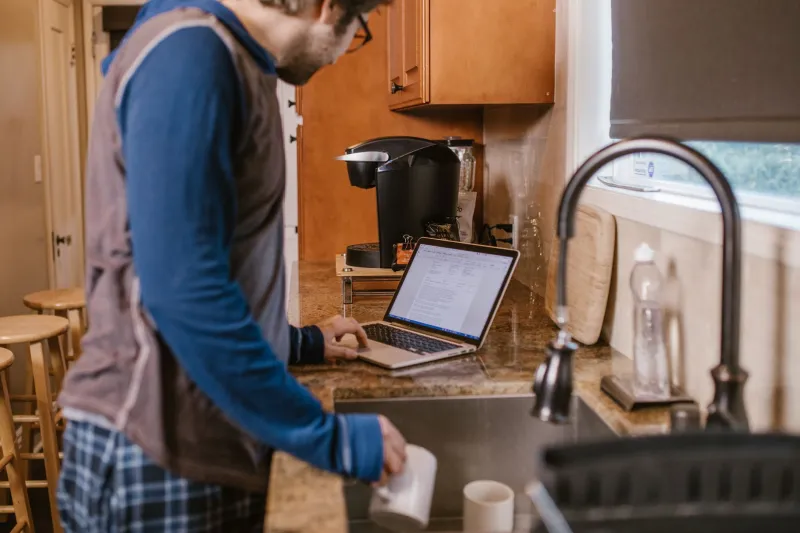
Of course, not everyone found their kitchen to be a productivity sanctuary.
The teams that struggled most weren't, on the whole, the ones with the most complex technical challenges. They were the ones whose working culture had been held together by proximity and implicit communication — the kind of organisation where problems got solved not through documentation or structured process, but through a quick spin of someone's chair and a muttered "have you seen what Dave's done to the staging environment."
British tech culture, particularly in smaller companies, has a notable allergy to writing things down. This is partly the startup instinct to move fast and not accrue documentation debt. It's partly, if we're honest, a class-inflected anxiety about appearing too formal or too corporate. Whatever the cause, the effect in a remote context was painful. Institutional knowledge that lived in people's heads and habits simply evaporated. Junior developers who'd been learning by osmosis — by sitting near someone good and absorbing their approach through some form of professional diffusion — suddenly had nothing to osmose.
One CTO at a mid-sized agency in Birmingham described it to us with admirable bluntness: "We discovered that about sixty percent of our onboarding process was 'watch what the person next to you does.' Remote work didn't break us. It just showed us we'd never actually built anything in the first place."
The European Comparison Nobody Wanted to Have
It became fashionable, around 2021, to benchmark British remote work culture against our European neighbours — and the comparisons were not always flattering.
German development teams, the narrative went, thrived remotely because they'd already built cultures of rigorous documentation, explicit process, and a refreshingly direct communication style that translated cleanly to async text. Dutch teams, similarly, were reported to have adapted well, partly because their cultural comfort with directness meant that remote feedback loops stayed honest rather than degenerating into the peculiarly British phenomenon of the passive-aggressive Slack message followed by three days of slightly strained stand-up calls.
There's something to this, though it's easy to over-romanticise. The same German directness that makes documentation culture natural also creates remote environments where, as one British developer who'd worked for a Hamburg-based firm put it, "every video call felt like a performance review, even the ones about lunch."
British remote culture, at its best, developed something different: a kind of warm, self-deprecating informality that worked surprisingly well across distributed teams. The group chat banter. The willingness to say "I haven't got a clue, has anyone else got a clue" in a way that somehow built trust rather than eroding it. The shared acknowledgement that everyone was muddling through, which, in a distributed team navigating genuine uncertainty, turned out to be more cohesive than it had any right to be.
What Got Found in the Kitchen
Five years on, most British developers who went remote have either returned to offices, settled into hybrid arrangements, or committed to full remote with the evangelical intensity of someone who has seen the light and will not stop mentioning it at family dinners.
What's interesting is what the experience changed permanently, even for those who went back.
The serendipitous pub networking never fully recovered — the industry is still, arguably, less connected than it was in 2019, and the informal knowledge transfer that happened around sticky tables has only partially migrated to Discord servers and LinkedIn posts. That's a genuine loss, and it's worth naming it clearly rather than pretending that a Zoom quiz is an adequate substitute for an actual conversation.
But something else was found, improbably, in those kitchens and spare bedrooms. A clearer sense of what actually needed human presence and what didn't. A grudging respect for documentation. And, for many British developers, a first real encounter with their own working rhythms — what they were like when the social performance of the office was stripped away.
As one developer in Cardiff summarised it, with the kind of accidental profundity that tends to emerge from people who've spent a lot of time alone with a kettle:
"I found out I was actually quite good at this job. I'd just never been left alone long enough to notice."
Not bad for a crisis that started with a spreadsheet and ended with a sourdough starter.