Your Napkin Knew Best: Why the First Scribble Beats the Fiftieth Slide
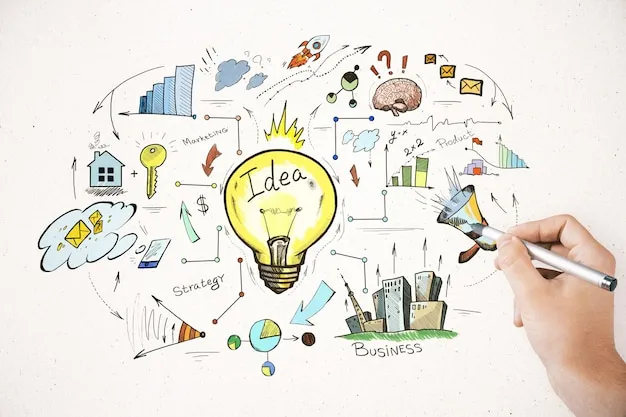
Photo: beer mat pen sketch idea startup brainstorm, via img.freepik.com
There's a peculiar moment that most British tech founders recognise, even if they're too polite to mention it in the retrospective. It usually happens somewhere around month four, when the product roadmap has ballooned into a seventeen-tab spreadsheet and the weekly alignment call has its own recurring sub-agenda. Someone digs out the original beermat — or the photo of it, crumpled and slightly damp — and holds it up against whatever the product has become.
Nine times out of ten, the beermat wins.
Not because the scribble was sophisticated. Not because whoever drew it had some prophetic gift for product design. But because the brutal constraint of a four-inch cardboard square forced a clarity that no amount of elaboration has managed to replicate.
The Tyranny of the Blank Slide Deck
Here's the problem with giving people room to think: they use it. All of it. And then they invite other people to fill the bits they missed.
A blank PowerPoint deck is an invitation to complexity. It whispers, go on, there's space for another bullet point, another edge case, another 'phase two' placeholder that everyone knows means never. Before long, your crisp little idea about automating invoice reminders for sole traders has acquired a machine learning layer, a white-label partner portal, and an integration with a CRM that nobody on the team has actually used.
The beermat doesn't do that. The beermat says: you've got room for one problem, one solution, and if you're lucky, a rough sketch of who's going to pay for it. That's not a limitation. That's a design brief.
Constraints as Creative Directors
British designers have always understood this, even when British businesses haven't. The entire history of good industrial design on these islands is essentially a story about doing more with less — from wartime utility furniture to the original Mini, which had to fit an engine, four adults, and a boot into something barely larger than a garden shed.
Software is no different. When Edinburgh-based founder Jamie Caldwell built the first version of his scheduling tool for independent music tutors, he did it on a single sheet of A5 paper during a delayed train journey from Waverley to King's Cross. Box for the teacher, box for the student, line between them with a time on it. Done. The product he launched eighteen months later — after workshops, wireframes, a UX agency, and three rounds of stakeholder input — had twelve screens where the paper had one concept.
Guess which version his first paying customers actually wanted.
Why Committees Can't Design Anything
The refinement process is supposed to make ideas better. In theory, more perspectives mean fewer blind spots, more testing means fewer surprises, and more documentation means fewer misunderstandings. In practice, it often means that every sharp edge gets sanded off until what remains is smooth, inoffensive, and completely without character.
Every person who touches a product idea in a meeting brings their own anxieties with them. The sales lead worries it won't appeal to enterprise clients. The developer worries about the API they'd have to build. The founder's co-founder worries it sounds too much like that other thing that failed in 2019. Each worry is reasonable in isolation. Collectively, they produce a product that has been optimised for not upsetting anyone — which is, as it turns out, a terrible way to build something people actually love.
The beermat sketch has none of that baggage. It was drawn by one person, probably slightly tired, probably a bit excited, in a moment when the only goal was to get the idea out of their head before it evaporated. It contains the raw signal before the noise arrived.
The Version Zero Instinct
There's a reason so many British founders, when pressed, can describe their original concept in a single sentence — and struggle to do the same for the product they actually shipped. The original concept was for a single sentence. It was never anything else.
This is what we'd call the Version Zero instinct: the unpolished, unjargonised, slightly embarrassing first articulation of what you're actually trying to do. It almost always contains the product's essential truth. Everything that comes after is either clarification or contamination, and the trick — the genuinely hard trick — is knowing which is which.
Some teams have started deliberately preserving their Version Zero. Not as a museum piece, but as a compass. Before a major feature decision, they pull up the original sketch and ask: does this serve the thing we drew, or does it serve the thing we became? It's a confronting question. It's also an extremely useful one.
Brevity as a Bullshit Filter
There's another function the beermat serves that rarely gets discussed: it's an outstanding detector of ideas that aren't actually ready yet.
If you genuinely cannot explain your product concept in the space of a beer mat — not the full technical specification, just the point of it — then something is wrong. Either the idea is too complex for its own good, or you don't yet understand it well enough to distil it, or there are three different ideas fighting for space inside what you're calling one product.
All of those are useful things to know before you spend six months and forty grand building it.
The beermat test isn't about dumbing things down. Plenty of genuinely sophisticated products can be summarised crisply: it tells landlords when their boiler is about to fail before it fails. It lets freelance translators invoice in any currency without thinking about exchange rates. It stops small charities accidentally emailing their donors twice. Complexity lives in the execution. Clarity lives in the concept. The beermat only asks you to nail the concept.
Getting Back to the Scribble
If your product has drifted — and most products drift, it's practically a law of nature — the cure isn't another workshop or another round of user research. It's a beermat and a biro.
Sit down. Ignore everything you've built. Ignore the roadmap and the personas and the competitive analysis. Ask yourself: what was I actually trying to fix? Write it down in the space you've got. If it doesn't fit, you're not done thinking yet.
The first sketch is rarely perfect. But it is almost always honest. And in a world that has developed an extraordinary appetite for complexity, honesty turns out to be a surprisingly powerful differentiator.
Your hundredth meeting had catering, a shared Miro board, and a follow-up action log. Your first beermat had an idea.
Back the beermat.